Retirement Money Before 59½: Five Routes Compared
Reach 401(k) and IRA money before 59½ without the 10% additional tax: Roth ladder, Rule of 55, 72(t), Roth basis, taxable bridge, and the years each covers.
You can reach 401(k) and IRA money before 59½ without the 10% additional tax through five main routes: Roth IRA contributions, a Roth conversion ladder, the Rule of 55, substantially equal periodic payments (72(t)), and a taxable account that needs no exception at all. Governmental 457(b) plans add a sixth for public employees. The routes differ in two ways that decide a plan: the age at which each one opens, and how many years of spending it can cover. Most early retirees need at least two of them, and the Roth ladder needs five years of other money before its first rung is usable.
This guide is general information about federal tax rules, not advice for your situation. Plan rules and state taxes vary.
Bridge years by route
The table compares the routes on what actually decides a bridge plan. "Bridge" means the years between your last paycheck and 59½.
| Route | Who can use it | Opens | Years of spending it can cover | What breaks it |
|---|---|---|---|---|
| Taxable brokerage account | Anyone with savings outside retirement accounts | Any age | Balance ÷ annual spending | Running out; it has no tax shelter |
| Roth IRA contributions | Anyone who made regular Roth IRA contributions | Any age; contributions come out first and are not taxed3 | Total contributed ÷ annual spending | Withdrawing past the contributions into earnings3 |
| Roth conversion ladder | Anyone with pre-tax IRA money (or 401(k) money moved to an IRA) | Each conversion: January 1 of the fifth year after the conversion year3 | One year per conversion, after five years funded from elsewhere | No money for years one to five |
| Rule of 55 | Someone who leaves an employer during or after the calendar year they turn 55; 50 for qualified public-safety employees2 | Separation year | Up to 59½, from that employer's plan only | Rolling the plan into an IRA; the exception does not apply to IRAs2 |
| 72(t) / SEPP | IRA owners at any age; employer-plan participants after leaving that employer4 | Any age | A fixed formula amount until the later of five years or 59½4 | Changing the amount early4 |
| Governmental 457(b) | State and local government employees | When the plan pays out | Balance ÷ annual spending | Money rolled in from other plan types carries the 10%1 |
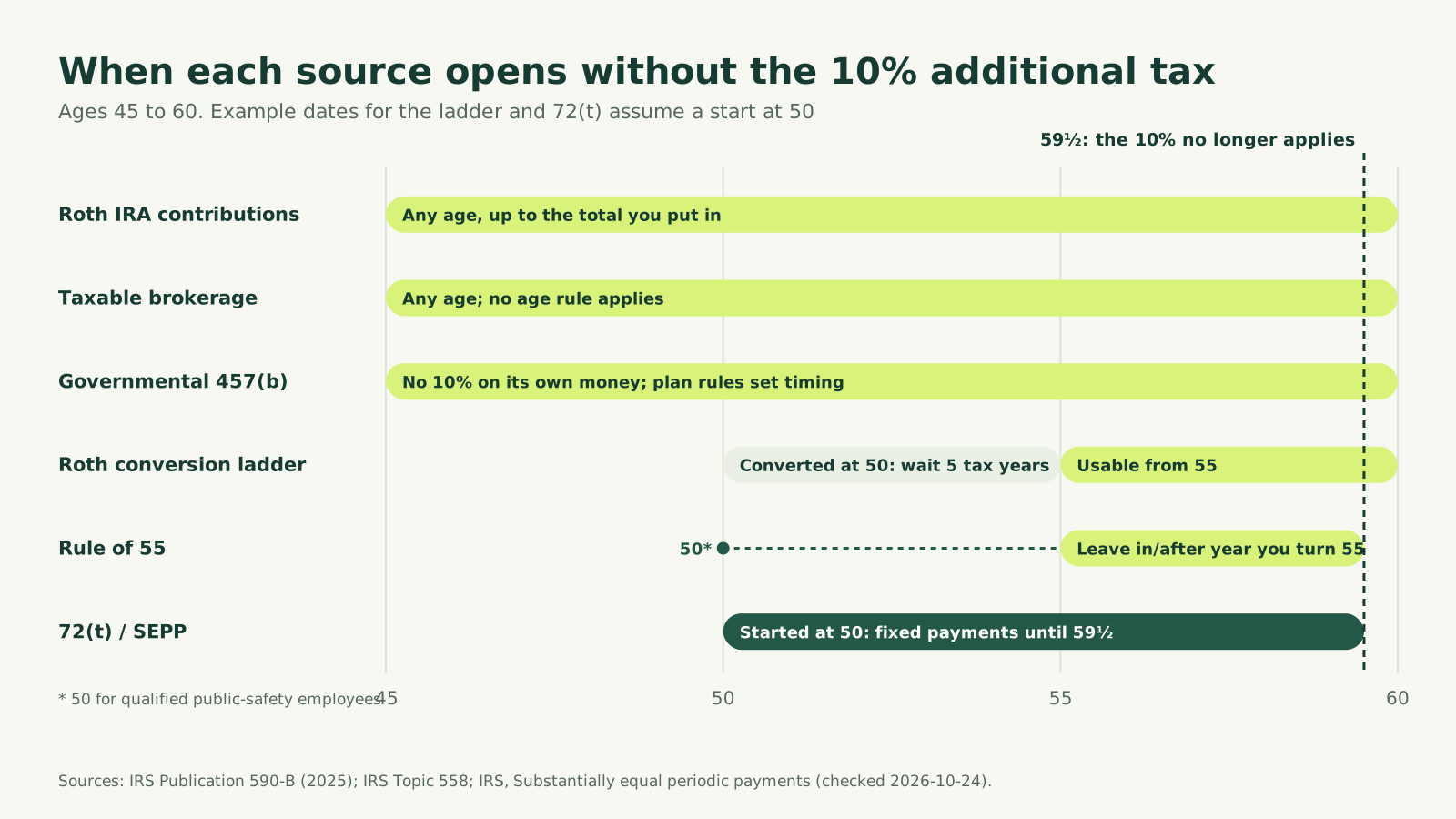
Read the table as a stack. The routes that open at any age (taxable money, Roth contributions, a 457(b)) carry the first years. The ladder takes over five years after the first conversion. The Rule of 55 only helps people who are still employed in the year they turn 55.
What the 10% applies to
Before 59½, the 10% additional tax applies to the part of a distribution that counts as gross income, on top of regular income tax.1 It covers 401(k), 403(b) and 403(a) plans and IRAs.1 Money that is not taxable when it comes out, such as Roth IRA contributions or a direct rollover, is not hit.1 Distributions that qualify for an exception are reported on Form 5329 when the 1099-R does not show the exception code.26
At 59½ the age exception covers every account, so all the routes below matter only for the years before it.2
Roth IRA contributions: money already within reach
Roth IRA withdrawals follow a fixed order: regular contributions first, then conversions oldest first, then earnings.3 Contributions were made with taxed money, so taking them back is not income and the 10% does not reach them. Earnings come out last, and before 59½ they are taxed and penalized unless an exception applies.3
The order covers all your Roth IRAs added together, not each account separately.3 Example: someone whose Roth IRA contributions over the years total $70,000 has $70,000 to draw on before 59½, whatever the accounts are worth now. Roth IRA withdrawals and conversions are reported on Form 8606.7 Keep your own record of contributions by year; it is the number that tells you how much is reachable.
The Roth conversion ladder and its five-year gap
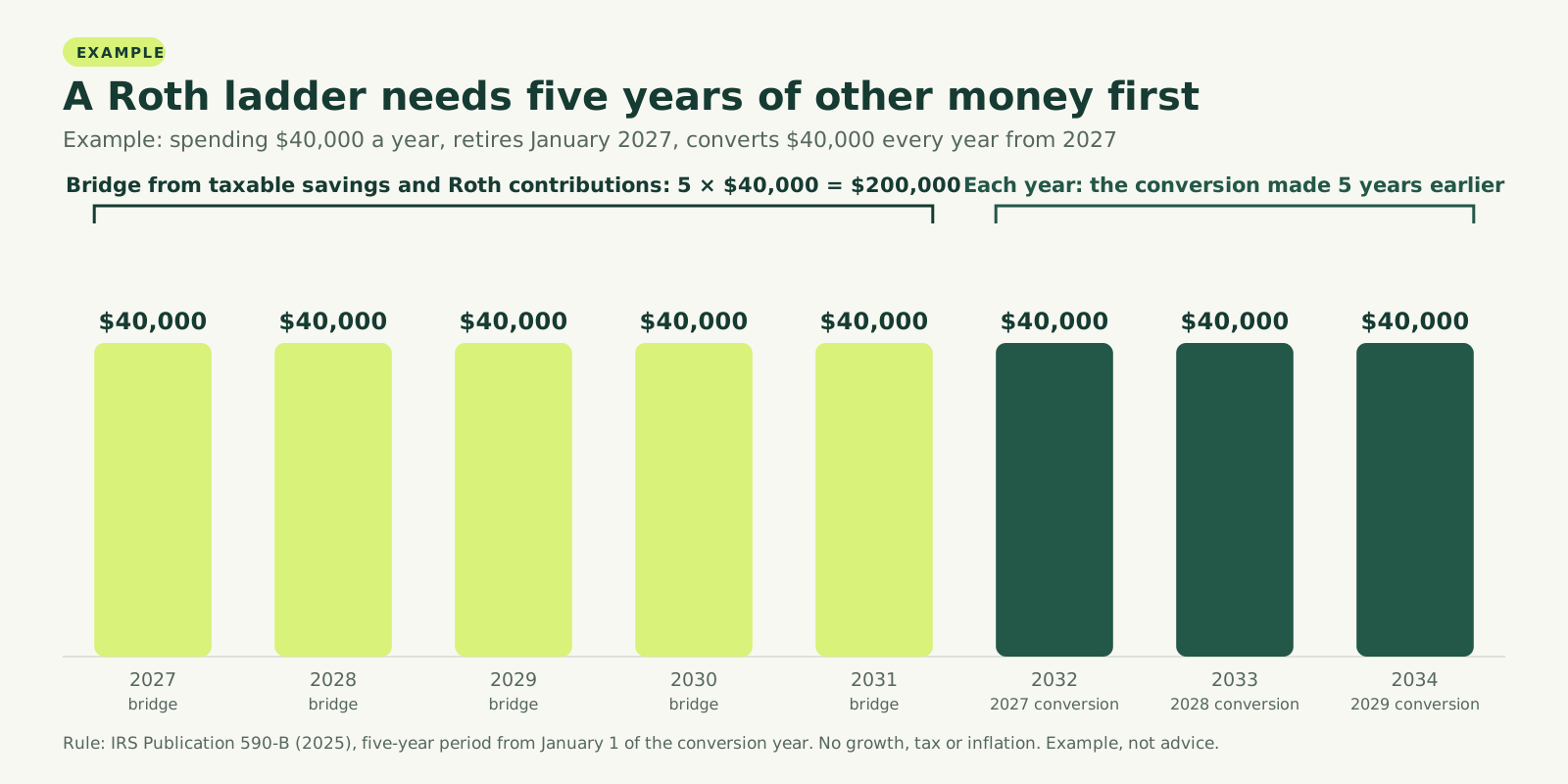
A ladder moves money from a traditional IRA into a Roth IRA a slice at a time. The taxable part of each conversion is income in the year you convert. Before 59½, a converted amount can come out without the 10% once a five-year period has passed, and that period starts on the first day of the tax year of the conversion, not on the conversion date.3 Each conversion has its own clock.3 A conversion made in March 2027 or in December 2027 clears on January 1, 2032.
That clock is separate from the five-year rule for qualified Roth distributions, which counts from the first year you contributed to any Roth IRA.3 The two are easy to mix up, and only the conversion clock matters for the 10%.3
How big the bridge has to be
Example (hypothetical numbers): a household spends $40,000 a year, retires in January 2027 and converts $40,000 every year from 2027. The 2027 conversion becomes reachable in 2032, the 2028 one in 2033, and so on. Spending for 2027 through 2031 has to come from somewhere else: 5 × $40,000 = $200,000 of taxable savings, Roth contributions, a 457(b), or one of the exceptions.
Two ways to shorten the gap, each with a cost:
- Start converting while still working. The clocks start earlier, but each conversion is taxed on top of a salary, usually at a higher rate.
- Convert more in the first year. One large conversion opens more money in year six but raises that year's taxable income.
Conversions and health premiums
A conversion is income in the year you make it. HealthCare.gov tells applicants to include most IRA and 401(k) withdrawals in their income estimate.8 Because marketplace premium help is set by income, the size of each conversion can change what you pay for coverage until Medicare. The guide to health coverage before Medicare shows the 2026 thresholds. Taking back Roth contributions is not taxable income, which is one reason people keep them for the ladder years.
Rule of 55: the year you turn 55, that plan only
If you separate from service during or after the calendar year you turn 55, distributions from that employer's plan avoid the 10%.2 For qualified public-safety employees of a state or local government plan, the age is 50.2 IRS Topic 558 adds that for these employees the exception also applies after 25 years of service under the plan, whichever comes first.1
Three details decide whether it works:
- The calendar year counts, not the birthday. Someone who turns 55 in December and leaves in March of that year qualifies. Someone who leaves the year before does not.2
- Only that employer's plan. The exception follows the separation from the employer that maintains the plan; a 401(k) from an earlier job is not covered by leaving a later one.1
- IRAs are excluded. The exception does not apply to IRAs, so rolling the 401(k) into an IRA after leaving gives it up.2 The 401(k) direct rollover guide covers that decision.
The Rule of 55 is about withdrawals. It has nothing to do with conversions, and it does not let you take money from an IRA. Plans also set their own payout options, so ask the plan administrator what withdrawals it allows after separation, before the separation date.
72(t) payments: reachable now, locked in for years
Substantially equal periodic payments (SEPP, often called 72(t) after the tax code section) avoid the 10% at any age. The amount comes from one of three IRS methods: required minimum distribution, fixed amortization, or fixed annuitization.45 The two fixed methods use an interest rate that may not exceed the greater of 5% or 120% of the federal mid-term rate.5
The rules that make SEPP rigid:
- Payments must continue unchanged until the later of five years after the first payment or 59½.4 Start at 50 and you are committed for nine and a half years. Start at 57 and you are committed until 62.
- No contributions to the account and no other withdrawals from it while the series runs.4
- Change the amount early and the 10% applies to every earlier payment, plus interest.4 One change is allowed: a single switch from a fixed method to the RMD method.4
- From an employer plan, you must leave that employer before payments begin. IRAs have no such condition.4
How much account a SEPP needs
The IRS's own example: a $400,000 IRA, owner aged 50, a 4% rate and a 36.2-year life expectancy produce $21,102 a year under fixed amortization, or $11,050 in the first year under the RMD method.4
Example, scaling the IRS factor: to produce $40,000 a year at 50 under fixed amortization, the account would need about $758,000 at 4% (40,000 × 18.9559) or about $663,000 at the 5% ceiling. Each SEPP is calculated on one account, and balances of several accounts cannot be combined for it.4
SEPP suits fixed spending. If your spending moves from year to year, the formula does not move with it.
Governmental 457(b) plans
Distributions from a governmental 457(b) plan are not subject to the 10% additional tax, except for money that came into the plan by rollover from another plan type or an IRA.21 When you can take the money is set by the plan. For a public employee with a 457(b), it can carry several bridge years by itself.
Paying the 10% instead: the arithmetic
The 10% is a cost, not a rule you break. Example: withdrawing $40,000 from a traditional IRA at 52 with no exception costs $4,000 in additional tax, on top of ordinary income tax that a conversion of the same amount would also trigger. Covering one short year this way costs 10% of what you take. Covering all five ladder years this way would cost $20,000 on $200,000 (Example).
Put that number next to the alternatives: the extra salary-year taxes of converting while working, the inflexibility of a SEPP, or working longer to build a taxable bridge. None of these is right in general; the arithmetic is what makes the comparison possible.
Writing a bridge plan
A bridge plan is a table of years and sources. Before choosing which account to fill next, write down:
- Years to cover. Your planned exit age to 59½. Leaving at 50 means nine and a half years.
- Money reachable at any age. Taxable balance plus Roth IRA contributions (not earnings), divided by annual spending.
- Ladder start. The first conversion year; its money opens on January 1 five years later.
- Rule of 55 or 457(b). Whether you will still be employed in the year you turn 55, or whether you have a governmental plan.
- The gap. Years still uncovered: fill them with more taxable saving, a SEPP from part of an IRA, or a planned 10%.
Example: someone leaving at 50 with $200,000 reachable and $40,000 of spending covers five years, which is exactly the ladder's waiting period if the first conversion is made in the exit year. The 4% rule guide covers how much the whole portfolio can support, and the FI number guide covers how much it needs to be.
If you are still deciding between pre-tax and Roth contributions, reachability is one of the inputs; Roth vs traditional covers the tax side. After-tax 401(k) money moved into a Roth account is another source, with its own rules on what comes out first; see the mega backdoor Roth guide.
Common mistakes
- All savings in a 401(k). The FI number is reached on paper, but little of it is reachable at 48 without a SEPP or the 10%.
- Rolling the 401(k) into an IRA at 55. That ends the Rule of 55 for that money.2
- Counting the ladder clock from the conversion date. It runs from January 1 of the conversion year.3
- Treating a SEPP as adjustable. Any change outside the one permitted switch brings back the 10% on every payment so far.4
- Ignoring the income side. Conversions and pre-tax withdrawals raise taxable income and can raise marketplace premiums.8
These rules affect penalties and eligibility. Before acting on a SEPP or a large conversion, have a CPA or enrolled agent check the numbers. The early retirement section covers the other two gaps early retirees plan for: health coverage before 65 and how long the portfolio has to last.
Sources
- Topic no. 558, Additional tax on early distributions from retirement plans other than IRAs, Internal Revenue Service. As of 2026-10-24.
- Retirement topics: Exceptions to tax on early distributions, Internal Revenue Service. As of 2026-10-24.
- Publication 590-B (2025), Distributions from Individual Retirement Arrangements (IRAs), chapter 2: Roth IRAs, Internal Revenue Service. As of 2026-10-24.
- Substantially equal periodic payments (FAQ), Internal Revenue Service. As of 2026-10-24.
- Notice 2022-6, Determination of substantially equal periodic payments, Internal Revenue Service. As of 2026-10-24.
- About Form 5329, Additional Taxes on Qualified Plans (including IRAs) and Other Tax-Favored Accounts, Internal Revenue Service. As of 2026-10-24.
- About Form 8606, Nondeductible IRAs, Internal Revenue Service. As of 2026-10-24.
- What's included as income, HealthCare.gov (Centers for Medicare & Medicaid Services). As of 2026-10-24.