Roth vs Traditional: Decide by Tax Rate Now vs Later
Roth or traditional 401(k) and IRA: at the same tax rate now and later they end equal. A 2026 bracket example shows when each wins, and what the HSA adds.
Roth and traditional accounts differ only in when you pay income tax: traditional money is taxed when it comes out, Roth money before it goes in. If your tax rate on the way out equals your rate today, the two end with the same after-tax amount. So the real question is which rate will be higher: your top rate on the pay you'd contribute now, or the rate you'll pay on withdrawals later. When you can't tell, splitting contributions between the two is a reasonable hedge, not a cop-out.
The same rate gives the same result
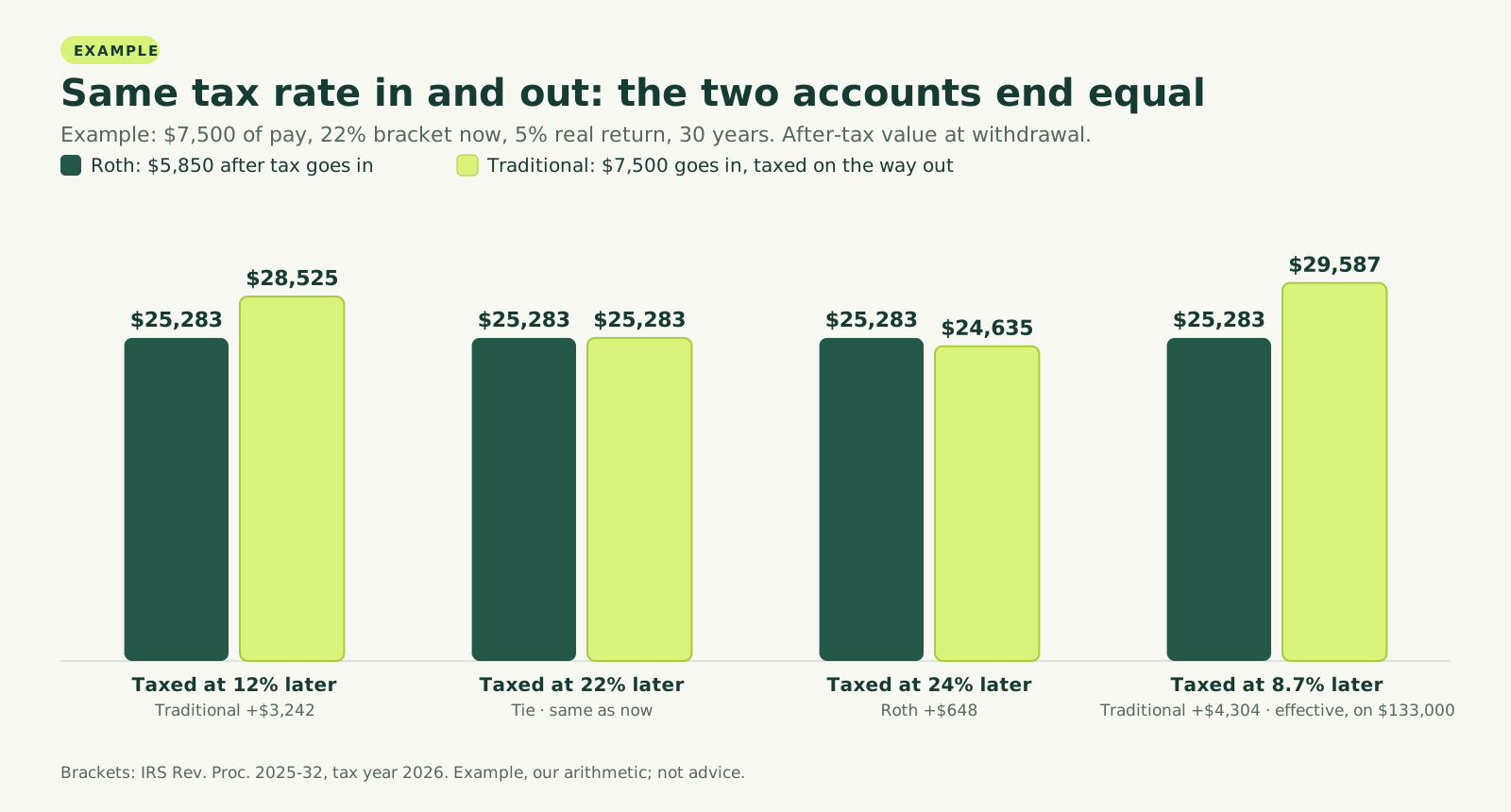
Example: you have $7,500 of pay to put toward retirement, you're in the 22% bracket, and the money earns a 5% real (after-inflation) return for 30 years, which multiplies it by about 4.32. With a Roth, you pay the 22% first and invest $5,850. With a traditional account, you invest the full $7,500 and owe tax at withdrawal. Both choices cost the same $7,500 of take-home pay.
| Example: tax rate on withdrawal | Traditional, after tax | Roth, after tax | Difference |
|---|---|---|---|
| 12% | $28,525 | $25,283 | Traditional +$3,242 |
| 22% (same as now) | $25,283 | $25,283 | None |
| 24% | $24,635 | $25,283 | Roth +$648 |
| 8.7% (effective rate, example below) | $29,587 | $25,283 | Traditional +$4,304 |
The 22% row is the whole idea. Multiplying by 0.78 and then by 4.32 gives the same product as multiplying by 4.32 and then by 0.78, so neither account has an edge built in. Every advantage comes from a difference between the two tax rates. For 2026 the federal brackets are 10%, 12%, 22%, 24%, 32%, 35% and 37%; for a single filer the 22% rate starts above $50,400 of taxable income and 24% above $105,700, and for a married couple filing jointly at $100,800 and $211,400.1
The example holds today's brackets fixed in real terms, which is what a real return assumes. Congress can change rates; nobody knows yours in 2056, and this page doesn't guess.
The rate later is usually not your bracket
The usual shortcut puts today's bracket against a guessed retirement bracket. That compares the wrong things. A contribution today is deducted at your top rate. A withdrawal later fills the brackets from the bottom: first the standard deduction, taxed at zero, then 10%, then 12%. What matters later is the average rate on the withdrawals, which can sit well below the bracket they end in.
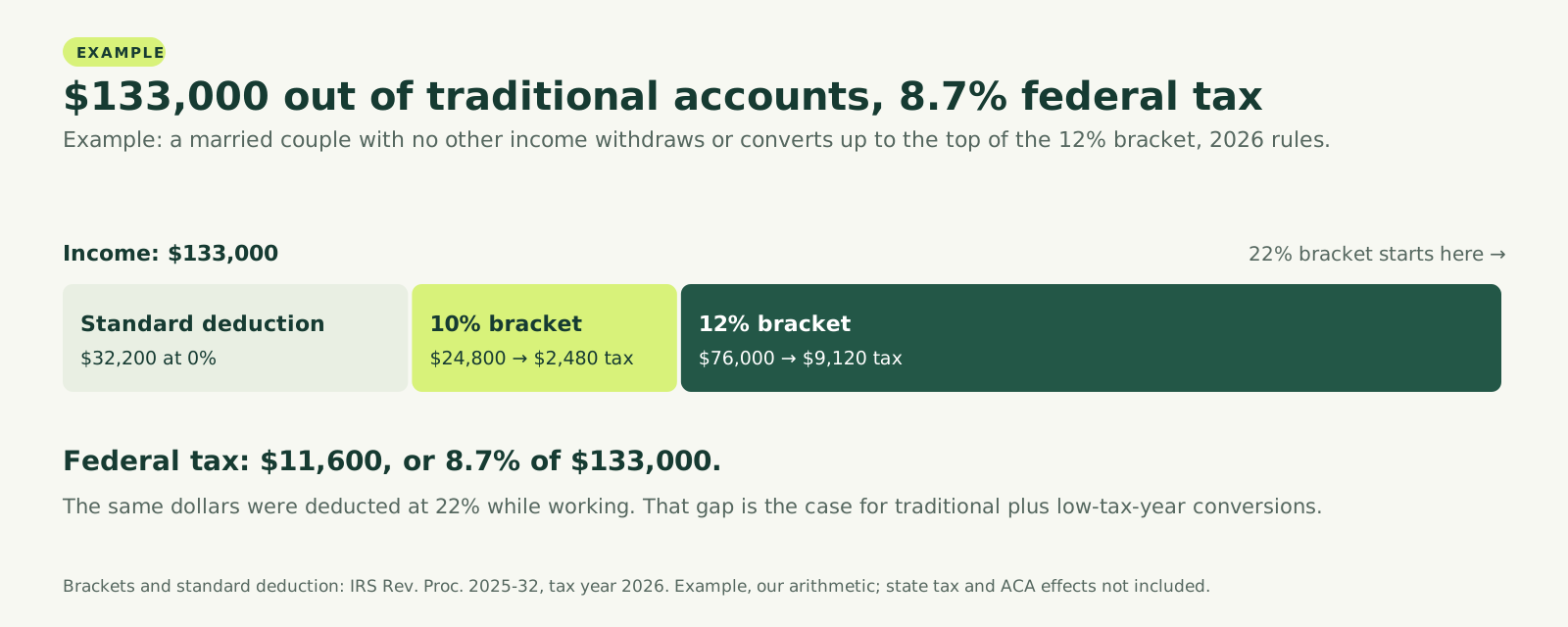
Example: a married couple with no other income takes $133,000 out of traditional accounts in one year under 2026 rules. The first $32,200 is covered by the standard deduction, the next $24,800 is taxed at 10%, and the following $76,000 at 12%.1 Federal tax is $11,600, an effective 8.7%. If that money had been deducted at 22% while they worked, the traditional account won by more than 13 percentage points.
The early-retirement window
The low-tax years are easiest to find between the last paycheck and the start of Social Security and required withdrawals. With little other income, those years can be used to convert traditional money to Roth a slice at a time, paying 10% or 12% on dollars that were deducted at 22% or 24%.1 A worker who expects such a window has a reason to favor traditional now, even in a middle bracket. The guide to retirement money before 59½ covers conversions and their five-year clock.
The window has a price for anyone buying marketplace health insurance before 65. Conversions and traditional withdrawals raise the income that sets premium tax credits, and the $133,000 in the example above would put many couples past the subsidy limit. The early-retirement health coverage guide has the income lines. Roth money taken out later doesn't add to that income, which is the case for holding some of both.
What else moves the answer
Five things shift the comparison away from the simple rate test.
- State income tax. Deducting in a high-tax state and withdrawing in a no-tax state favors traditional; the reverse favors Roth.
- Social Security taxation. Whether your benefits are taxed depends on your modified AGI plus half your benefits.13 Traditional withdrawals are taxable income and count toward that test; qualified Roth distributions aren't included in income.8 A large traditional balance can make part of your benefits taxable and raise your real rate later.
- Required minimum distributions. Traditional IRAs and 401(k)s generally require withdrawals starting at 73.6 Roth IRAs and designated Roth accounts in a 401(k) or 403(b) have none while the owner is alive.6 For Roth 401(k)s that rule is new: SECURE 2.0 removed lifetime RMDs for taxable years beginning after December 31, 2023.7 Beneficiaries still face RMD rules.6
- The employer match. Matching money has traditionally gone in pre-tax, whatever you chose for your own deferrals. SECURE 2.0 lets a plan offer Roth matching contributions, which count as income to you in the year they're made; plans don't have to offer it.10 If yours doesn't, part of your savings is traditional already.
- Hitting the limit. The 2026 limit on 401(k) deferrals is $24,500, Roth and traditional combined.2 A dollar of Roth holds more after-tax value than a dollar of traditional, so someone who maxes out shelters more with Roth. Example: $24,500 of Roth deferrals is worth what $31,410 of traditional deferrals would be at 22%, and the second number isn't allowed.
Income limits close some doors. A Roth 401(k) has no income limit.14 Direct Roth IRA contributions phase out between $153,000 and $168,000 of modified AGI for single filers and between $242,000 and $252,000 for married couples filing jointly in 2026.2 On the traditional side, the IRA deduction phases out between $81,000 and $91,000 for a single filer covered by a workplace plan.2 A traditional IRA contribution you can't deduct breaks the equivalence above, because nothing went in pre-tax.
The 2026 Roth catch-up rule for higher earners
From 2026, catch-up contributions are no longer a free choice for everyone 50 or older. If your FICA wages from the employer sponsoring the plan were over $150,000 in 2025, your 2026 catch-up contributions to that plan must be Roth.34 The catch-up amount is $8,000 for 2026, or $11,250 at ages 60 to 63.23
The final regulations generally apply from 2027; for 2026, plans may follow a reasonable, good-faith reading of the law, and some governmental and collectively bargained plans get a later date.5 Ask your plan how it applies the rule this year. Your regular deferrals up to $24,500 stay your choice.2
Getting money out before 59½
A common belief is that Roth money is the kind with penalties. For an IRA it's closer to the reverse.
- Roth IRA. Distributions come out in a set order: your regular contributions first, then conversions, then earnings. Returns of regular contributions aren't included in income, so neither tax nor the 10% additional tax reaches them.8
- Roth 401(k). A distribution that isn't qualified (for most people, one taken before 59½ or within five years of the first Roth contribution) is treated as coming pro rata from earnings and contributions, so part of it is taxable.9
- Traditional 401(k) or IRA. Withdrawals are taxed as income, and before 59½ the taxable part generally also owes the 10% additional tax unless an exception applies.8
Moving a Roth 401(k) into a Roth IRA changes which set of rules applies; the direct rollover guide covers the move. The retirement money before 59½ guide covers exceptions to the 10%.
Where the HSA fits
A health savings account can beat both. Contributions are deductible, earnings grow untaxed, and distributions for qualified medical expenses are tax-free, so money spent on care is never taxed at all.12 Money taken for anything else is taxable and, before 65, owes an additional 20% tax; from 65 the 20% no longer applies, so non-medical withdrawals are then taxed much like traditional ones.12 You need coverage under a high-deductible health plan to contribute. The 2026 limits are $4,400 for self-only coverage and $8,750 for family coverage.11
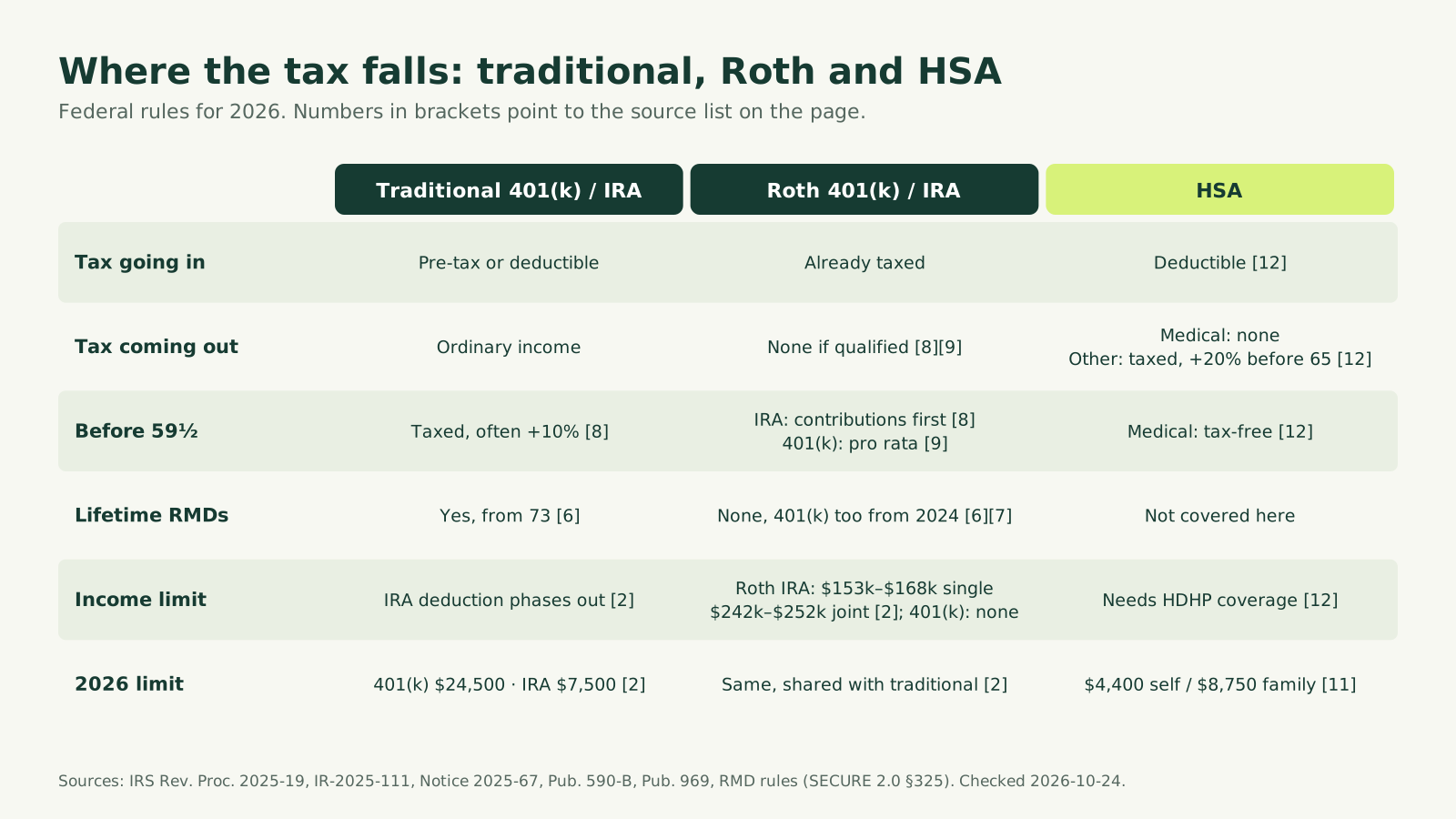
The same comparison as a table, with sources:
| Traditional 401(k) / IRA | Roth 401(k) / IRA | HSA | |
|---|---|---|---|
| Tax going in | Pre-tax or deductible | Already taxed | Deductible12 |
| Tax coming out | Ordinary income | None if qualified89 | None for medical costs; otherwise taxed, plus 20% before 6512 |
| Before 59½ | Taxed, generally plus 10%8 | IRA: contributions first, untaxed8; 401(k): pro rata9 | Medical: untaxed at any age12 |
| Lifetime RMDs | From 736 | None, Roth 401(k) included from 202467 | Not covered on this page |
| Income limit, 2026 | IRA deduction phases out from $81,000 (single, covered at work)2 | Roth IRA: $153,000–$168,000 single, $242,000–$252,000 joint2; Roth 401(k): none14 | Requires HDHP coverage12 |
| Contribution limit, 2026 | 401(k) $24,500; IRA $7,5002 | Same limits, shared with traditional2 | $4,400 self-only, $8,750 family11 |
A decision rule
Start from your marginal rate on the contribution and your likely effective rate on withdrawals, then adjust for the points above.
- Lean traditional when your marginal rate is 22% or higher now and you expect years of low taxable income later, especially an early-retirement window you can fill with conversions at 10% or 12%.1
- Lean Roth when your rate is 10% or 12% now, when you expect a large traditional balance, a pension or a high-tax state later, or when you already max out the limit and want more after-tax value inside it.1
- Split when the two rates look close or you can't estimate them. The match may already make part of your savings traditional, so count it before you choose your own share.
The choice isn't permanent. You can change your deferral election each year, and traditional money can still be converted to Roth later, at the tax rate of the year you convert.
For after-tax 401(k) contributions above the deferral limit, see the mega backdoor Roth guide. For account limits, fees and index funds as a category, go back to on investing.
Sources
- Revenue Procedure 2025-32: 2026 inflation adjustments, tax rate tables (§1(j)(2)) and standard deduction (§63(c)), Internal Revenue Service. As of 2025-10-09.
- 401(k) limit increases to $24,500 for 2026, IRA limit increases to $7,500 (IR-2025-111), Internal Revenue Service. As of 2025-11-13.
- Notice 2025-67: 2026 Amounts Relating to Retirement Plans and IRAs (Roth catch-up wage threshold, §414(v)(7)(A)), Internal Revenue Service. As of 2025-11-13.
- Retirement topics – Catch-up contributions, Internal Revenue Service. As of 2026-10-24.
- Treasury, IRS issue final regulations on new Roth catch-up rule, other SECURE 2.0 Act provisions (IR-2025-91), Internal Revenue Service. As of 2025-09-15.
- Retirement topics – Required minimum distributions (RMDs), Internal Revenue Service. As of 2026-10-24.
- Internal Revenue Bulletin 2024-33: final required minimum distribution regulations, including SECURE 2.0 Act §325 (designated Roth accounts), Internal Revenue Service. As of 2024-08-12.
- Publication 590-B (2025), Distributions from Individual Retirement Arrangements (IRAs), Internal Revenue Service. As of 2026-10-24.
- Retirement topics – Designated Roth account, Internal Revenue Service. As of 2026-10-24.
- Notice 2024-2: Miscellaneous changes under the SECURE 2.0 Act of 2022, section L (§604, designated Roth matching contributions), Internal Revenue Service. As of 2023-12-20.
- Revenue Procedure 2025-19: 2026 inflation-adjusted amounts for health savings accounts, Internal Revenue Service. As of 2025-05-01.
- Publication 969 (2025), Health Savings Accounts and Other Tax-Favored Health Plans, Internal Revenue Service. As of 2026-10-24.
- Topic no. 423, Social Security and equivalent Railroad Retirement benefits, Internal Revenue Service. As of 2026-10-24.
- Roth 401(k), Roth IRA, and pre-tax 401(k) retirement accounts (Roth comparison chart), Internal Revenue Service. As of 2026-10-24.