Debt Avalanche vs Snowball: Both Methods on the Same Five Debts
Avalanche and snowball run month by month on five example debts: $571 apart in interest, first payoff in month 3 vs 16, and a rule for when the gap matters.
The debt avalanche sends every spare dollar to the highest interest rate first; the snowball sends it to the smallest balance first. On the same debts and the same monthly payment, the avalanche never pays more interest than the snowball. How much less depends on your debts. In our five-debt example the gap is $571 and one month, while the snowball clears its first debt in month 3 instead of month 16. When the smallest balances also carry the highest rates, the two methods are the same plan.
Which debts to attack before building savings is covered in personal finance foundations, which owns the "emergency fund or credit card first" order. This page assumes that step is settled and compares the two payoff orders.
The example: five debts, $1,228 a month
Example, with assumed balances. The card rates sit around the Federal Reserve's latest average: in the November 6, 2026 release, accounts that were charged interest paid 22.36% on average in August 2026 (21.19% across all card accounts). The same release puts the average 24-month personal loan at 11.90% and the 60-month new car loan at 7.54%.1
| Debt (example) | Balance | APR | Monthly minimum | Avalanche order | Snowball order |
|---|---|---|---|---|---|
| Card A | $9,000 | 23.99% | $270 | 1st | 4th |
| Card B | $2,500 | 20.49% | $75 | 2nd | 2nd |
| Card C | $1,100 | 18.49% | $35 | 3rd | 1st |
| Personal loan | $5,500 | 11.90% | $182 | 4th | 3rd |
| Car loan | $11,000 | 7.54% | $266 | 5th | 5th |
| Total | $29,100 | $828 |
The household pays $828 in minimums plus $400 extra, $1,228 every month until the last debt is gone. Our assumptions, applied to both methods:
- interest is APR divided by 12 on each month's balance;
- card minimums are 3% of the starting balance, and the loan payments are their 36- and 48-month amortized payments;
- each minimum stays fixed in dollars, and when a debt is paid off its minimum rolls to the next target;
- no new charges on any account.
What happens month by month
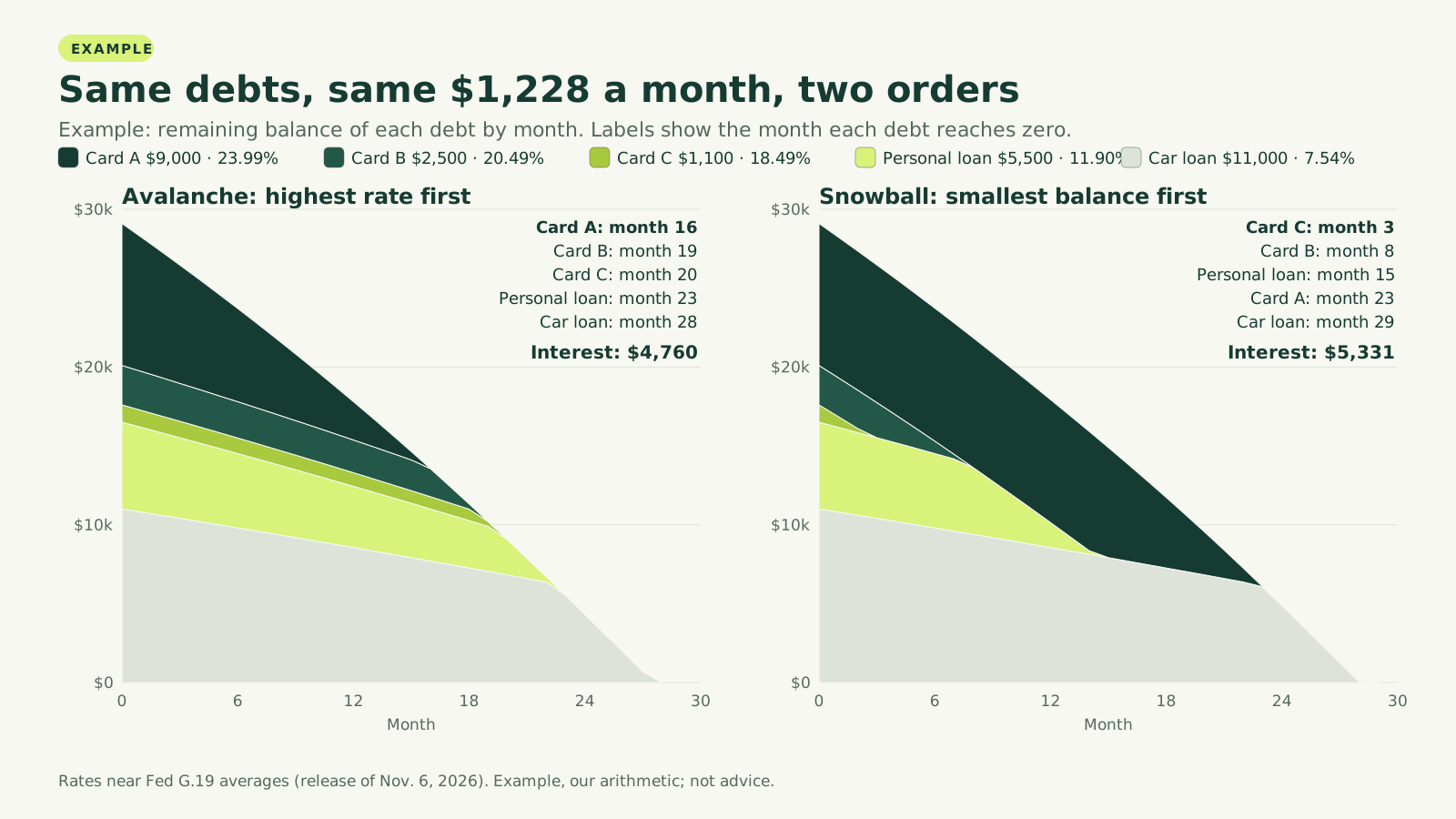
| Example result | Avalanche | Snowball |
|---|---|---|
| Total interest paid | $4,760 | $5,331 |
| Months to debt-free | 28 | 29 |
| First debt gone | Card A, month 16 | Card C, month 3 |
| Debts closed by month 15 | 0 | 3 |
| Interest paid on Card A alone | $1,586 | $3,130 |
| Month each debt is gone | A 16, B 19, C 20, loan 23, car 28 | C 3, B 8, loan 15, A 23, car 29 |
The whole $571 difference comes from one place. The snowball leaves the $9,000 card at 23.99% for last among the cards and even pays off the 11.90% personal loan before it, so the card waits 23 months instead of 16 and builds up nearly twice the interest. The car loan is the largest balance and the cheapest rate, so both methods leave it for last and it costs about the same either way.
What the snowball buys with that $571 is visible in the table: three debts closed in the time the avalanche closes none. Fifteen months with nothing paid off is the risk the snowball is meant to remove.
When the gap is small and when it is large
We ran the same simulation with different extra payments and with the rates changed one at a time. Each figure below is an example: snowball interest minus avalanche interest, same debts and same rules as above.
| Example variant | $0 extra | $100 | $200 | $400 | $800 |
|---|---|---|---|---|---|
| The five debts above | $16 | $399 | $557 | $571 | $452 |
| Card A at 29.99% instead of 23.99% | $51 | $974 | $1,227 | $1,144 | $837 |
| All three cards at 22.36% | $0 | $115 | $257 | $323 | $283 |
| Cards only, rates as above | $2 | $251 | $234 | $174 | $111 |
| Cards only, all at 22.36% | $0 | $0 | $0 | $0 | $0 |
Three patterns come out of it, and they give a working rule:
- The gap is zero when the two orders agree. If your smallest balance also has the highest rate, or all the rates are the same, both methods send money to the same place. Our cards-only variant at one rate shows $0 at every payment level.
- The gap is set by the high-rate balance the snowball makes wait. Example: moving Card A from 23.99% to 29.99% roughly doubles the gap, to $1,144 at $400 extra. Cards a few points apart cost $111 to $251 over the whole payoff. A loan near 12% paid ahead of a card near 24% is what pushes our main example to $571.
- The gap peaks at moderate extra payments. Example: with no extra money the order barely matters ($16), because almost everything goes to minimums. With $800 extra everything is gone fast and the gap shrinks again ($452). In between, the gap is largest.
So, as a rule of thumb: sort your debts both ways. If no debt with a lower rate sits ahead of a larger debt with a much higher rate (several percentage points or more), the snowball costs little. If one does, the price grows with the rate difference, the size of the balance that waits and the months it waits.
A hybrid that keeps most of the savings
You don't have to pick a pure version. Example: pay Card C ($1,100) first for one quick win, then switch to the avalanche. Card C is gone in month 3, same as the snowball, and total interest is $4,847, which is $87 more than the pure avalanche instead of $571 more. Debt-free in 28 months either way. For a set shaped like this one, that is the version we would start from. If your first avalanche payoff is only a few months away, skip the detour: the pure avalanche gives up nothing.
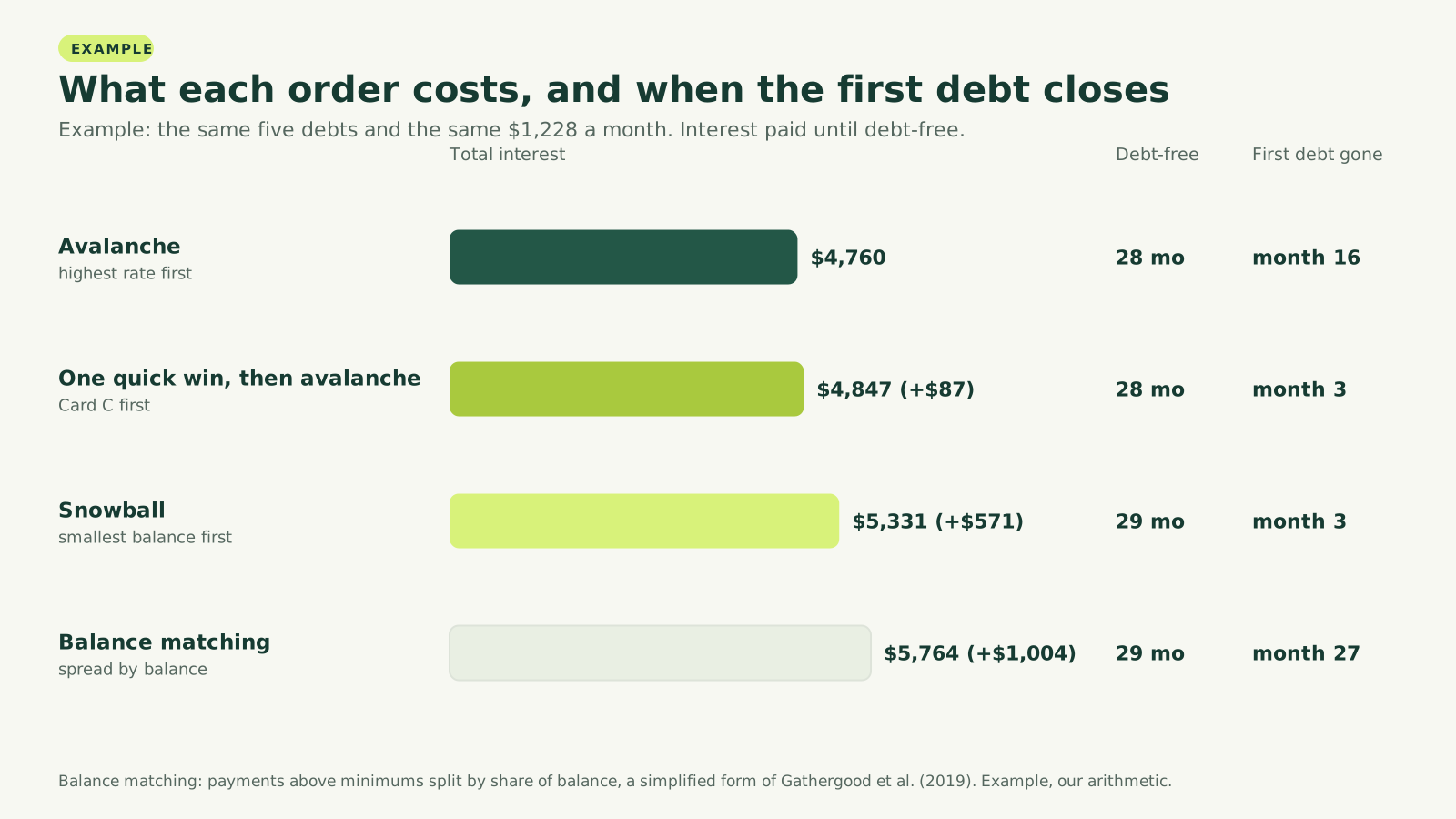
The fourth bar is the one to watch. In linked data on people with several credit cards, Gathergood and coauthors found repayments were not directed to the higher-rate card; instead each card's share of repayments tracked its share of balances, and that pattern explained more than half of the predictable variation in repayments.6 Applied to our example, spreading the extra $400 by balance costs $5,764 in interest, $1,004 more than the avalanche and $433 more than the snowball, and no debt is gone until month 27. Picking either method, and sticking to it, beats the default.
What the research says about motivation
The case for the snowball is behavioral, and there is real research behind it. It is narrower than it is often presented.
- People lean toward closing small debts even when it costs them. In a debt-management game across four experiments, Amar, Ariely and coauthors found participants paid off small debts first even when larger debts carried higher rates. Pointing their attention at the interest each debt had built up, and limiting their ability to pay off small debts in full, helped them reduce total debt faster.2 These were games, not real accounts.
- Closing accounts went with finishing. Gal and McShane studied records of nearly 6,000 clients of a debt settlement firm. The share of accounts a client had closed predicted completing the program better than the share of dollars repaid.34 The data are observational, the clients were in a settlement program, and the authors note that accounts closed and dollars repaid are hard to separate. Their suggestion to start small was framed for cases where the interest rates on the small and large balances differ only modestly.4
- Concentrating payments raised motivation, most of all on the smallest account. Kettle, Trudel, Blanchard and Häubl reported a field study and three experiments in which putting repayments on one account rather than spreading them made people more motivated to get out of debt. The effect was strongest when the concentrated payments went to the smallest account, because people judge overall progress by the largest proportional drop in a single balance.5
Taken together, the research supports concentrating on one debt at a time and suggests a small, early payoff helps some people keep going. It does not show that the snowball pays off more debt than the avalanche for someone who will stick with either one. Gal and McShane's own caveat matches what our simulation found: when rates differ a lot, starting small has a price.
Run it on your own debts
Copy this table and fill in one row per debt. Leave out debts you are not trying to pay early, such as a low-rate fixed mortgage.
| Debt | Balance | APR | Minimum | Rank by rate (avalanche) | Rank by balance (snowball) |
|---|---|---|---|---|---|
If the two rank columns match, there is nothing to choose. If they don't, look at each debt that moves up in the snowball column and compare its rate with the rates of the debts it jumps ahead of. A few points on a small balance costs little; a large balance at a much higher rate left waiting costs the most, as the variant table shows.
Last, count the months until the avalanche closes its first debt. If that is more than a year away and the wait worries you, the hybrid is the middle ground.
Mistakes that cost more than the choice of method
Letting the payment shrink. Card minimums usually fall as the balance falls. If you pay only the statement minimum, the money freed by a paid-off debt never rolls to the next one, and neither method works. Both rely on keeping the total payment fixed, $1,228 in the example, until the last debt is gone.
Charging new balances on cleared cards. Paying off Card C and using it again restarts the race. The snowball clears accounts earliest, so it opens that door soonest.
Ranking a zero-interest promotional balance by today's rate. A promotional rate ends. Rank it by the rate it will carry afterward, and check whether the payment you plan clears it before the promotion ends.
Not re-ranking. Variable card rates change, and a new debt changes both orders. Re-sort when either happens.
Counting on an extra payment you don't have. If the extra payment exists only on paper, the method does not matter. The budgeting strategies comparison shows where a fixed debt payment fits in each method.
If a car repair would land back on a card, a starter cushion comes first; the guide to sizing an emergency fund works out how large.
This page explains how the two methods behave on example numbers. It is general education, not advice for your situation.
Sources
- Consumer Credit - G.19, release of November 6, 2026: Terms of Credit (credit card plans, personal loans, new car loans; latest quarterly rates: August 2026), Board of Governors of the Federal Reserve System. As of 2026-11-19.
- Winning the Battle but Losing the War: The Psychology of Debt Management (Journal of Marketing Research, vol. 48, special issue, 2011, pp. S38–S50), Moty Amar, Dan Ariely, Shahar Ayal, Cynthia E. Cryder and Scott I. Rick. As of 2011-11-01.
- Can Fighting Small Battles Help Win the War? Evidence from Consumer Debt Management (Journal of Marketing Research, vol. 49, 2012, pp. 487–501), David Gal and Blakeley B. McShane, Kellogg School of Management. As of 2012-08-01.
- To Beat Debt, Consider Starting Small (Kellogg Insight, summary of Gal and McShane, 2012), Kellogg School of Management, Northwestern University. As of 2026-11-19.
- Repayment Concentration and Consumer Motivation to Get Out of Debt (Journal of Consumer Research, vol. 43, no. 3, 2016, pp. 460–477), Keri L. Kettle, Remi Trudel, Simon J. Blanchard and Gerald Häubl. As of 2016-10-01.
- How Do Individuals Repay Their Debt? The Balance-Matching Heuristic (American Economic Review, vol. 109, no. 3, 2019, pp. 844–875), John Gathergood, Neale Mahoney, Neil Stewart and Jörg Weber. As of 2019-03-01.