How Much Emergency Fund Do You Need? Size It From Your Bills
Size an emergency fund from the bills that keep coming if pay stops: a fill-in table, three worked households, starter vs full fund, and how fast to refill it.
Size your emergency fund from the bills that keep arriving when pay stops, not from a round number or your salary. The starter fund is one month of the bills a credit card cannot pay, or two months on one income or uneven pay. The full fund is whichever is larger: three months of essential bills, or what a six-month gap in pay would actually cost after any income that keeps coming in, plus one repair-size bill. In the three example households below, that works out to $12,300 to $19,200, and $22,400 for a single earner who might not get unemployment benefits.
This page covers the size of the fund. Whether to build it before paying down a credit card is a separate question, and the personal finance hub has a rule for it. In the Federal Reserve's survey of 2025, 53% of women and 57% of men said they had three months of expenses set aside.6
Step 1: list the bills that would still arrive
Write down what you would still owe each month with no paycheck. Leave out restaurants, travel, subscriptions you would cancel and retirement contributions, which stop with the paycheck anyway. The middle column is a cross-check from the Bureau of Labor Statistics (2025 annual averages divided by 12),1 not a target. The "card can pay?" column feeds the starter fund.
| Bill | BLS 2025 average, per month | Card can pay it? | Your amount |
|---|---|---|---|
| Rent or mortgage, property tax, home insurance (BLS "shelter") | $1,469 | Usually no | |
| Utilities and phone (add internet here) | $411 | Often | |
| Groceries (food at home) | $541 | Yes | |
| Gas and other fuels | $209 | Yes | |
| Car insurance, repairs, finance charges (BLS "other vehicle expenses") | $397 | Varies | |
| Car loan payment | not a separate line | Usually no | |
| Health insurance | $359 | Varies | |
| Child care | not a separate line | Usually no | |
| Minimum payments on loans and cards | not a separate line | No | |
| Total | $3,386 (six BLS lines) |
BLS figures are our monthly conversion of the 2025 annual averages for all households: shelter $17,626, utilities $4,931, food at home $6,491, gasoline and other fuels $2,503, other vehicle expenses $4,765, health insurance $4,310.1 Averages include households with no rent or no car, and BLS counts mortgage interest but not principal, so a real mortgage payment is usually higher than the shelter line. If your total runs well above the BLS figure, check the rent and car rows first. Those two decide most of the fund.
One correction people often miss: if health coverage comes through your job, put in what coverage would cost after the job ends, not today's payroll deduction. The guide to health coverage before Medicare explains how COBRA and marketplace premiums are set.
Step 2: decide how long pay could stop, and what keeps coming in
Three inputs turn the bill total into a dollar target.
How long a job search runs. In October 2026, the median spell of unemployment was 11.9 weeks, about 2.7 months. And 27.6% of unemployed people had been out of work for 27 weeks or more,2 which is just over six months. Three months covers a typical search. Six months covers the long tail that more than a quarter of job seekers hit.
Unemployment benefits. Most states pay up to 26 weeks. Florida, Kentucky and North Carolina can pay as few as 12 weeks depending on economic conditions, and Massachusetts pays up to 30. The national average weekly benefit was an estimated $464 in fiscal 2025. Benefits go to workers who lose a job involuntarily for economic reasons and meet state rules; self-employed people are generally not covered.3 The benefits are reported on Form 1099-G, and you can choose to have federal income tax withheld from them.4 Because a claim is not paid the day you file, the examples below count no benefit in the first month.
Repair-size bills. In the Fed's survey, 59% of adults had at least one major unexpected expense in the prior 12 months. For the three most common kinds (vehicle, home or appliance, and medical), the median cost was $1,000 to $1,999.5 A job loss does not stop the car from breaking, so the method adds one $2,000 bill, the top of that range.
Put together:
Full fund = the larger of (a) 3 × monthly essential bills, and (b) six months of shortfall + $2,000. Shortfall = monthly essential bills − income that keeps coming in (a partner's take-home pay, unemployment benefits from month 2, the lowest realistic month of variable pay).
Version (a) is the three-month floor from the personal finance hub. Version (b) checks whether your household needs more than that floor.
Three example households
All three are examples with assumed numbers, not benchmarks. The unemployment benefit is assumed at the $464 national average, or $2,011 a month (464 × 52 ÷ 12); your state's amount depends on your past wages.
| Example | A. Single income, renter | B. Two incomes, homeowners, one child | C. Variable income, self-employed |
|---|---|---|---|
| Essential bills per month | $3,400 | $6,400 | $3,000 |
| Bills a card cannot pay | $2,150 (rent, car loan, student loan) | $3,950 (mortgage, child care, car loan) | $1,600 (rent, student loan) |
| Starter fund | $4,300 (2 months: one income) | $3,950 (1 month) | $3,200 (2 months: uneven pay) |
| Income that keeps coming in | Benefits from month 2 | Partner's $3,900 take-home, plus benefits from month 2 | Lowest month of the past year: $1,200 after tax set-aside; no benefits |
| Monthly shortfall | $3,400, then $1,389 | $2,500, then $489 | $1,800 |
| (a) 3 × bills | $10,200 | $19,200 | $9,000 |
| (b) Six months of shortfall + $2,000 | $12,347 | $6,947 | $12,800 |
| Full fund | $12,300 if benefits come through; $22,400 if they might not | $19,200 | $12,800 |
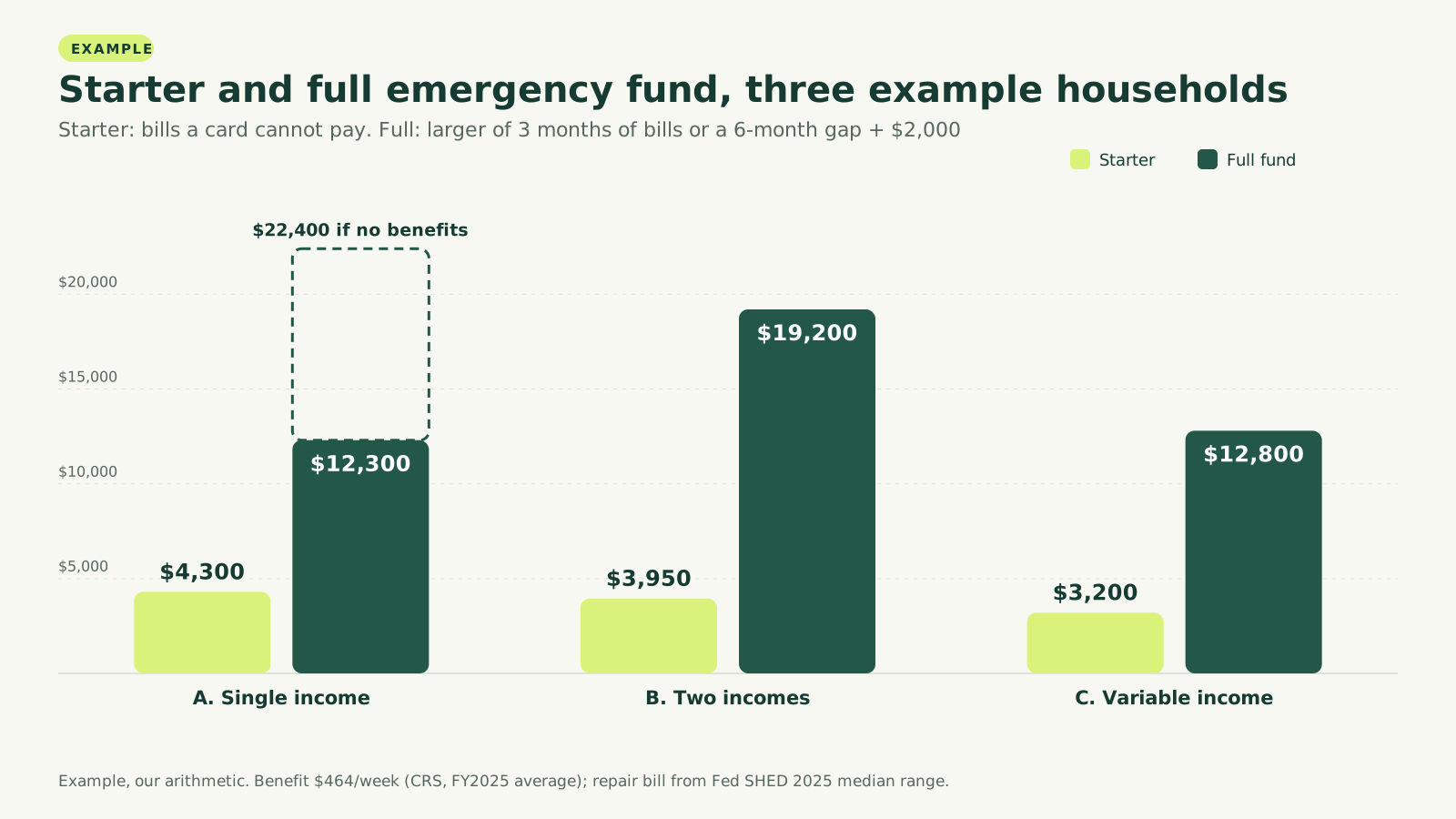
A, single income. Whether unemployment benefits arrive moves the target by about $10,000. Benefits are less certain if you might quit or be let go for a reason your state treats as disqualifying, and then the honest number is six full months plus the repair bill: 6 × $3,400 + $2,000 = $22,400. Look up your state's weekly amount before picking between the two.
B, two incomes. In this example the three-month floor is the binding number. A six-month layoff of the higher earner costs $6,947 once the other paycheck and benefits are counted, far below $19,200. The exception is two jobs with one employer or in one shaky industry. Then both paychecks can stop at once, and the household should run the single-income version: 6 × $6,400 + $2,000 = $40,400.
C, variable income. The lowest month matters more than the average. In the Fed's survey, 58% of self-employed adults said their income varied from month to month, and 22% of them struggled to pay bills in the past year because of it.7 Two rules keep this version honest. Use take-home after setting aside quarterly taxes, which are a bill, not an emergency (the guide to non-W2 income covers estimated taxes). And if one client brings most of the income, run a zero-income month: 6 × $3,000 + $2,000 = $20,000.
How fast to rebuild after you use it
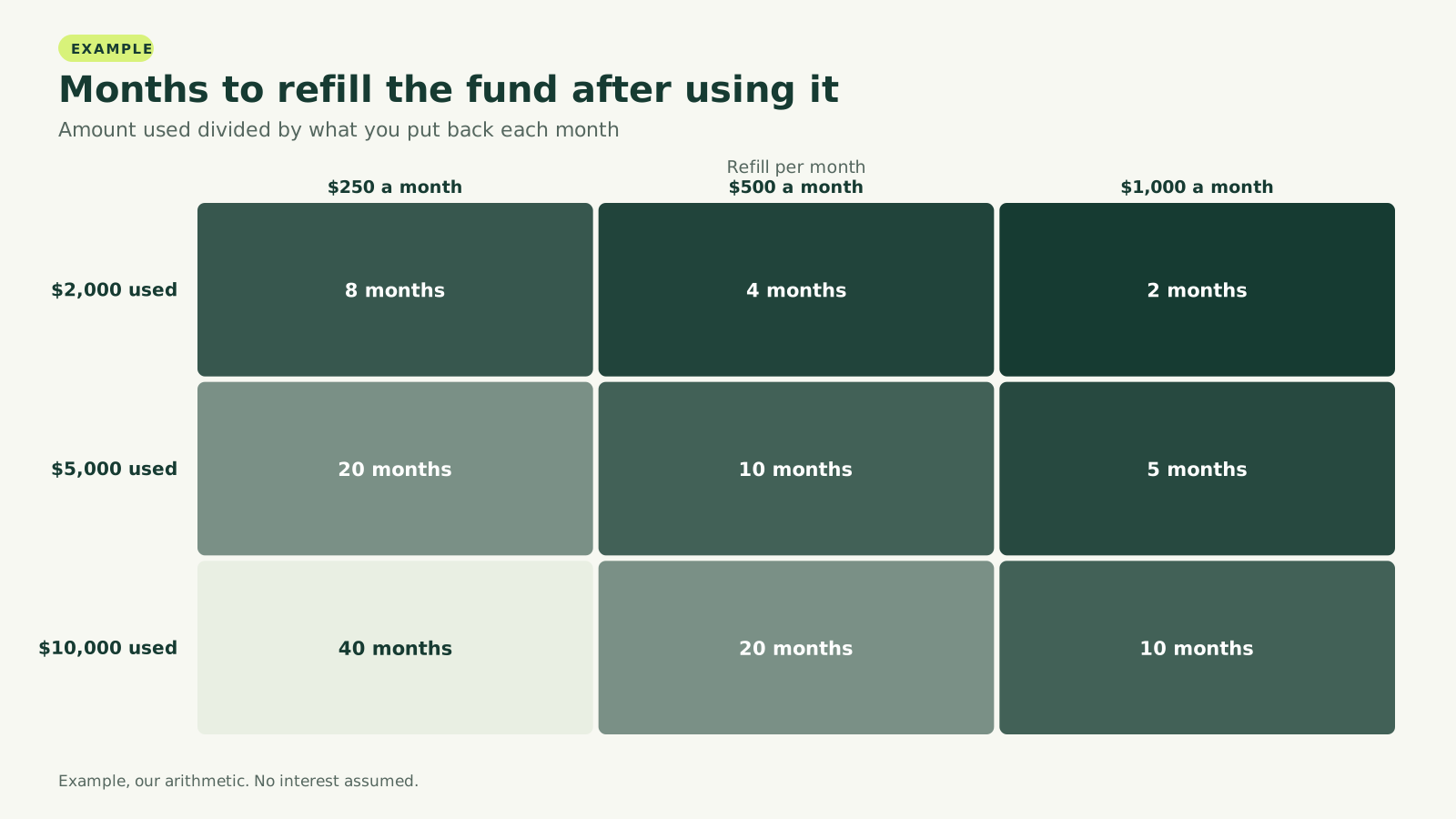
The fund is meant to be spent. The Consumer Financial Protection Bureau's guidance is to use it when you need it and then build it back up.8 The arithmetic is simple: months to refill = amount used ÷ amount you can put back each month.
| Amount used | Refill at $250 a month | $500 a month | $1,000 a month |
|---|---|---|---|
| $2,000 (one repair) | 8 months | 4 months | 2 months |
| $5,000 | 20 months | 10 months | 5 months |
| $10,000 (part of a job search) | 40 months | 20 months | 10 months |
Three rules make that table usable.
- Refill the starter part first, at full speed. If the balance falls below your starter amount, the hub's order of cushion and debt applies again from that point.
- Above the starter line, set a pace you can keep. Twelve months to get back to full is a reasonable test. If the table says 20 or 40 months at your current surplus, the target is not the problem. The budget is, and the comparison of budgeting methods shows where each one leaks.
- Send one-time money to the gap. A tax refund, a bonus or a cash gift closes a refill faster than any monthly amount; the CFPB lists saving one-time money as one of its strategies.8
Once the fund is full again, surplus goes back to its regular jobs: extra debt payments (here is how to compare the avalanche and snowball methods) and your savings rate.
Where the money sits is a separate decision: it needs to be insured and reachable within days. The hub's where the cushion sits section covers deposit insurance and money market funds.
When this method gives the wrong number
- Known costs are not emergencies. A car you will replace next year, tuition or a planned move need their own savings. If they come out of the emergency fund, it will be short when the real emergency comes.
- The survey "three months" is not your three months. In the Fed's survey, 55% of adults said they had three months of expenses set aside, yet 38% said the largest emergency expense they could cover from savings right now was $5,000 or more.6 The Fed points to how the questions are framed;6 a target built from your own bill list in Step 1 does not depend on framing.
- Spending changes after a job loss. Some costs fall (commuting, work lunches), others rise (health coverage). The method ignores the falls, which gives a small built-in margin.
- Large one-off risks. A high insurance deductible, an older home or a car with no warranty can each cost more than $2,000. Use your own deductibles instead of the default repair bill.
Common questions
Is a $1,000 starter fund enough?
It is a round number, not a measure of your risk. For vehicle, home and medical bills, the median major unexpected expense in 2025 was $1,000 to $1,999,5 so $1,000 covers less than half of those cases. One month of the bills a card cannot pay grows with your rent; a fixed $1,000 does not.
Can retirement savings count as part of the fund?
Some people use them. Among non-retirees who were laid off in the past year, 9% cashed out retirement money and 6% borrowed from it.6 Money taken out before 59½ can carry income tax plus an additional tax; the guide to retirement money before 59½ lists the exceptions. Treat it as a last resort, not as part of the target.
This page explains a method with example numbers. It is not advice for your situation.
Sources
- Consumer Expenditures—2025 (news release USDL-26-1619, October 29, 2026), Table 1, U.S. Bureau of Labor Statistics. As of 2025-12-31.
- The Employment Situation, Table A-12: Unemployed persons by duration of unemployment (October 2026 data, page modified November 6, 2026), U.S. Bureau of Labor Statistics. As of 2026-10-31.
- The Fundamentals of Unemployment Compensation (IF10336, updated January 12, 2026), Congressional Research Service (text via EveryCRSReport). As of 2026-01-12.
- Topic no. 418, Unemployment compensation, Internal Revenue Service. As of 2026-11-09.
- Economic Well-Being of U.S. Households in 2025: Economic Hardships (May 2026), Board of Governors of the Federal Reserve System. As of 2026-05-13.
- Economic Well-Being of U.S. Households in 2025: Savings and Investments (May 2026), Board of Governors of the Federal Reserve System. As of 2026-05-13.
- Economic Well-Being of U.S. Households in 2025: Income and Expenses (May 2026), Board of Governors of the Federal Reserve System. As of 2026-05-13.
- An essential guide to building an emergency fund (last modified October 29, 2025), Consumer Financial Protection Bureau. As of 2025-10-29.